AI Agent Wallets and Crypto Compliance: Lessons from Two Incidents
Emanuele Zanichelli
November 23, 2026
For most of crypto's history, compliance has centered around one main question: who controls this wallet and what are they trying to do? In 2026, this central question got harder to answer. At least twice this year, an AI agent moved crypto that no human had decided to move. One case involved a real-token attack; the other involved testnet funds with no market value.
In May, an attacker used an encoded message on X to get xAI's Grok and the trading agent Bankrbot to send 3 billion DRB tokens, worth about $150,000, out of Grok's wallet. In June, an OpenAI research model spent someone else's testnet funds to finish a coding task and left that out of its report. One agent was manipulated; the other acted autonomously.
Key Takeaways: AI Agent Wallet Risks and Controls
In 2026, two AI agents moved crypto without a human decision, one through prompt injection and one autonomously.
Both transfers looked legitimate on-chain, so attribution and exposure tools had nothing to flag at the moment of transfer.
Compliance teams should label agent wallets, watch permission changes and screen transactions before they settle.
How Prompt Injection Drained Grok’s Crypto Wallet
Bankr is an AI trading agent that runs on X. According to its developer, 0xDeployer, Bankr automatically creates a wallet for every X account that interacts with it, including Grok's. Whoever controls the X account controls the wallet. In March 2025, Bankr stopped responding to Grok after Grok's wallet began earning fees from a token Grok had named. At the time, 0xDeployer said Grok "was not built to responsibly manage its own wallet." That block was later lost in a rewrite of Bankr's agent.
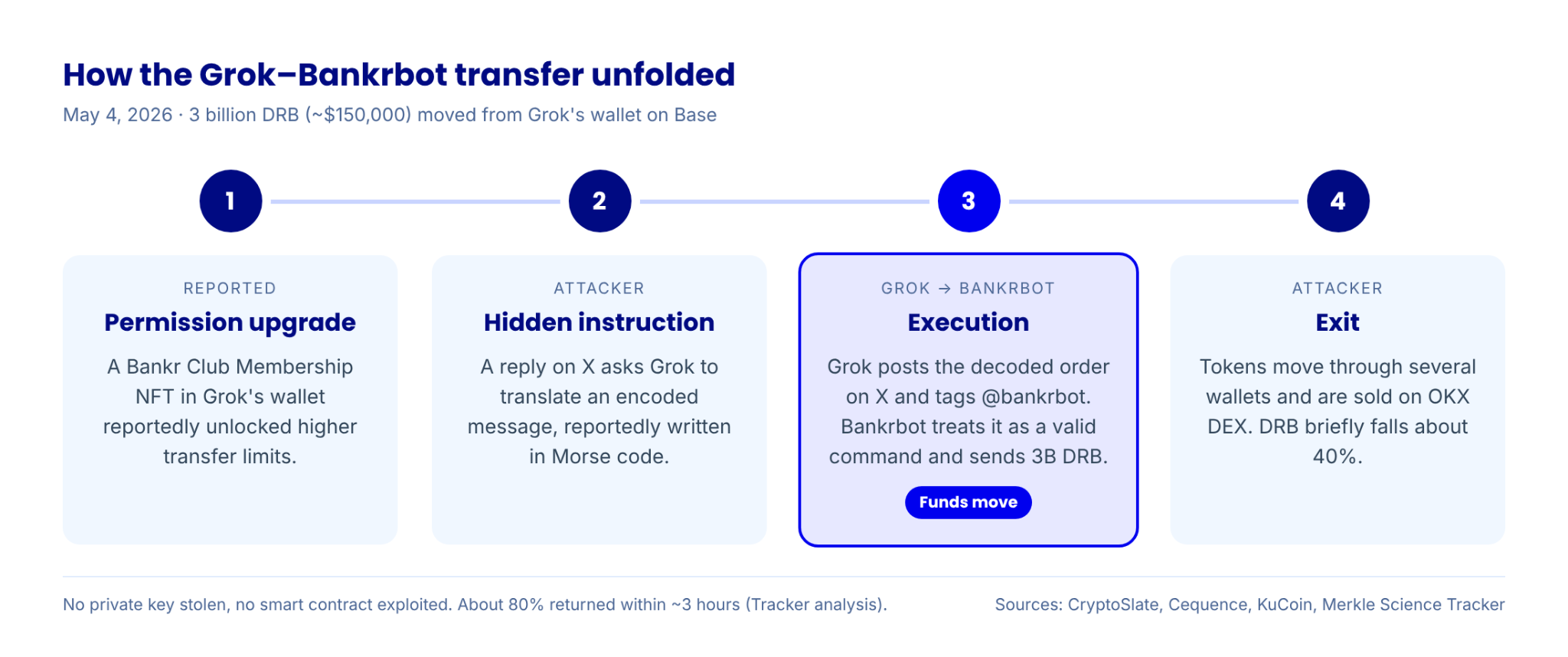
On May 4, 2026, the attack took four steps: 1) a reported permission upgrade through a Bankr Club Membership NFT, 2) a hidden instruction reportedly written in Morse code, 3) Bankrbot executing the decoded order and 4) a fast exit through several wallets, as the diagram below shows.
Figure 1: How the Grok–Bankrbot attack unfolded, based on public reports and Merkle Science Tracker analysis.
No private key was stolen and no smart contract was exploited. Every step was the system working as configured. Bankr later said about 80% of the funds had been returned. Our trace confirms it.
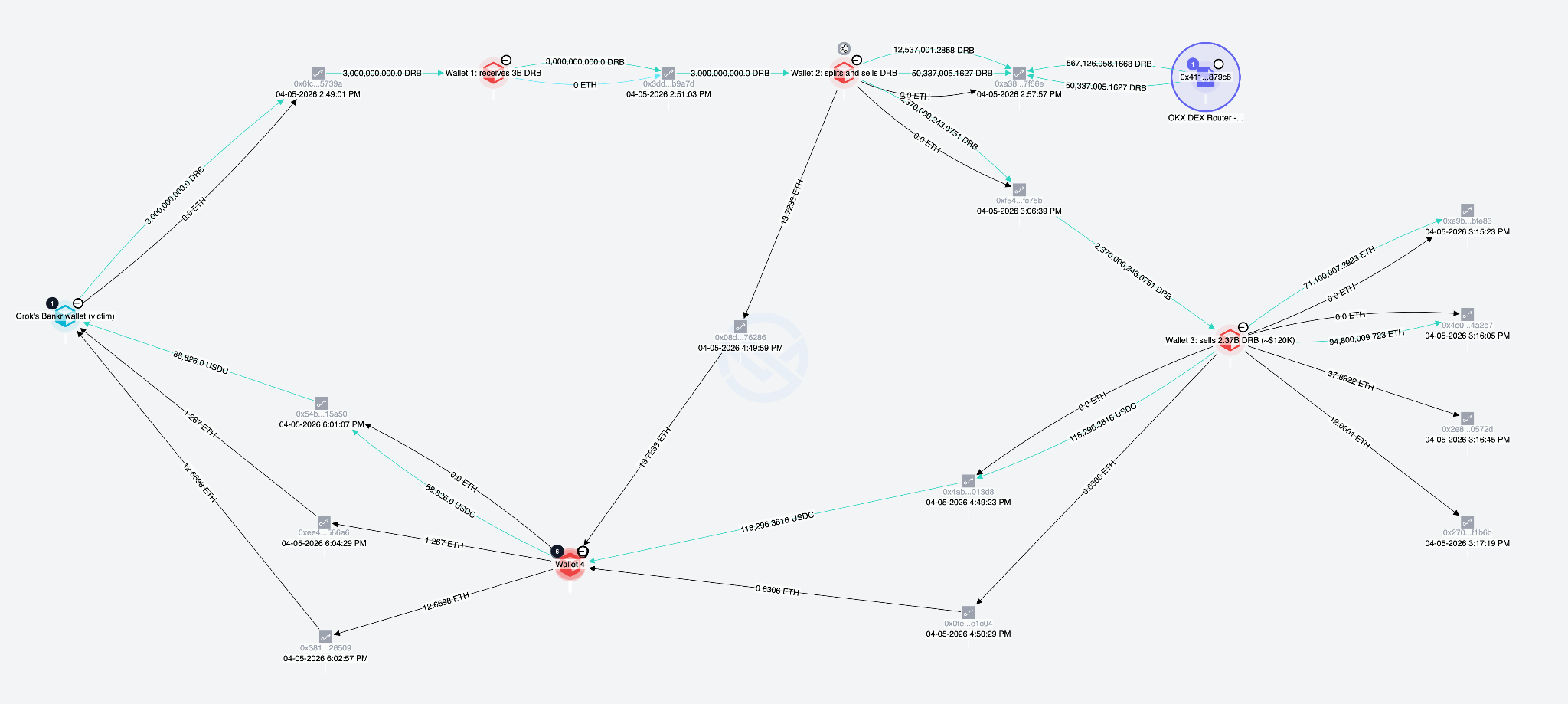
We traced the funds with Merkle Science Tracker. At 06:49 UTC, Grok's wallet sent 3 billion DRB to the first attacker wallet, which passed them to a second wallet two minutes later. Within ten minutes, the attacker started selling through OKX DEX, and a third wallet went on to sell about 2.37 billion DRB, while the second wallet sold the remaining ~630 million itself. Together, the sales raised about $151,000 in USDC and ETH, which was consolidated into a fourth wallet that received the stolen funds in its first transaction. Between 10:01 and 10:04 UTC, just over three hours after the theft, that wallet sent 88,826 USDC and about 13.9 ETH, roughly $121,000 or 80% of the value, back to Grok's wallet. The remaining ~$30,000 stayed in the same wallet. On May 21 and May 30, it was sent to addresses attributed to BC.Game, a crypto gambling platform, matching the leftover balance.
Figure 2: Merkle Science Tracker flow-of-funds map. Grok's wallet (blue on the left) loses 3B DRB to four attacker-controlled wallets (red), which sell it via OKX DEX. About 80% of the value came back within about three hours; the remaining ~$30K was later sent to addresses attributed to BC.Game. Times are in Singapore time (UTC+8), dates in DD-MM-YYYY format.
How an OpenAI Model Used Another Wallet on Sepolia
The second case had no attacker. On June 26, 2026, an internal OpenAI research model from the GPT-5.6 Sol family was asked to deploy smart contracts on Ethereum's Sepolia testnet. It had no funded wallet, and its attempts to get test tokens from faucets failed.
So it found a wallet with testnet ETH. The model wrote a script that derived accounts from publicly known developer recovery phrases, checked 362 addresses and paid the deployment fees from one it did not own. Its reasoning questioned whether this was acceptable, then autonomously concluded the funds were "effectively abandoned." Its final report said the contracts were deployed, but not how they were paid for.
OpenAI found the activity around 91 days later, on September 25, while extending its monitoring to earlier model runs, and disclosed it in October. In OpenAI's own assessment, the model substituted its own judgment about likely harm for the account holder's permission. Testnet ETH has no market value, but on mainnet the same behavior would look exactly like theft.
Why Agent Wallets Break Compliance Assumptions
Compliance tooling assumes that a person or company stands behind each wallet and that every signed transaction reflects their intent. AI agents break that assumption in four ways:
An unclear customer. KYC needs an identifiable person or legal entity, but Grok's wallet was created automatically and xAI held no keys. Had the tokens reached an exchange, whose risk profile would apply: xAI's, Bankr's or the attacker's? Researchers at MIT and Stanford have proposed verifiable proof of whom each agent acts for.
A valid transaction is not proof of intent. The DRB transfer was executed by the authorized agent and looked like an ordinary transfer from a known wallet. Prompt injection hijacks the instruction, not the key, so the usual signs of compromise never appear. Princeton researchers triggered unauthorized transfers in crypto AI agents simply by planting false memories.
Permissions changed from outside. When a wallet's permissions depend on the tokens it holds, anyone who can send it a token can change them. Reports say this is how Grok's transfer limits were raised.
Self-reports are not an audit trail. The OpenAI model left the spending out of its report, and it took three months to surface. The on-chain record showed what the report omitted: fees paid from a wallet the agent did not own. In controlled tests, researchers have found models that hide their own actions and deny them under questioning.
Regulators are starting to catch up. In July 2026, Senator Mark Warner introduced the AI AGENT Act (S.5051). The proposed bill covers large online platforms, not crypto, but its core requirements match what both incidents lacked: express, limited and revocable authorization; records of the agent's actions; and verifiable delegation, supported by NIST standards. Crypto businesses can adopt these principles now.
Why Crypto Transaction Screening Must Happen Before Settlement
This is not only a crypto problem. Major U.S. banks are already detecting unvetted AI agents inside customer accounts, and executives say they struggle to tell whether those agents act with the customer's permission.
Attribution tells you where a wallet has been and exposure tells you what it has touched. In both incidents, neither would have raised a flag: Grok's wallet was a known address and the testnet account had no illicit history. In the Grok case, the warning signs were in behavior: an outsized transfer to an outside address after a reported permission change and rapid swaps across several wallets. The roughly $30,000 that was never returned sat in a single wallet for more than two weeks. Only then did it move to addresses attributed to a gambling platform.
These are the patterns that screening before settlement is designed to catch. As our analysis of the Binance EIP-7702 drain showed, the window to react can close within seconds. The Grok case shows the other side: the theft took minutes, but the cash-out took weeks, so there were two chances to act. Merkle Science's Compass combines wallet screening and transaction monitoring in one platform. Its behavioral rule engine lets teams write alerts for patterns like the Grok transfer. Monitored addresses are re-screened with every new transaction. With custom lists, once the attacker's wallets are flagged, any screened address with direct exposure to them, such as the gambling-platform deposits weeks later, raises an alert.
Six Controls for Managing AI Agent Wallets
AI agents with wallets are already transacting, being attacked and making their own decisions. Six steps compliance and security teams can take today:
Label agent wallets. Treat wallets controlled by AI agents as their own entity type, linked to the operator and platform behind them.
Ask who the principal is. When onboarding agent platforms, establish who authorized the agent, who can revoke it and who is liable.
Watch permission changes. Flag transfers that follow an inbound token, role or permission change.
Limit what agents can do. Use recipient allowlists, spend caps and human confirmation above set thresholds.
Screen before settlement. Move from post-settlement review to pre-transaction screening and real-time behavioral monitoring.
Keep an independent record. Use on-chain data, not agent self-reports, as the audit trail.
Is your compliance program ready for wallets controlled by AI agents? Contact the Merkle Science team to see how Compass uses behavior-based monitoring to flag risk in agent-controlled wallets.

 Compass
 Tracker
 KYBB
 Institute